


Research-backed data on magnetic shark deterrents, bite statistics, and what independent government studies reveal about reducing shark encounters
Shark deterrents are now tested by governments and universities, not just by the companies that sell them. Western Australia's fisheries department found deterrents cut the probability of sharks taking hooked fish by 65%, and Florida Atlantic University recorded an eightfold difference in deterrence between a Sharkbanz magnet and a non-magnetic dummy. Yet confusion persists about what actually works. The Sharkbanz 2 wearable deterrent represents the battery-free, always-on approach to shark safety, backed by government field trials and 20+ years of peer-reviewed magnetic deterrent research.
This statistical breakdown examines what the data actually shows, including where the evidence is strongest, where limitations exist, and what ocean users should understand before entering the water.
Key Takeaways
- Bull sharks show strong deterrent response: Independent FAU research documented zero bites on magnet-protected bait versus 9 bites on control bait from bull sharks, with bulls approaching the Sharkbanz magnetic device far less often (19 vs 52 approaches).
- Shark deterrents can reduce depredation: Western Australia's DPIRD study tested the Sharkbanz Zeppelin alongside electric and acoustic deterrents, finding that the three technologies collectively reduced the probability of hooked fish being taken by sharks by 65% compared with fishing without deterrents.
- Shark encounters remain consistent: The International Shark Attack File recorded 65 unprovoked bites worldwide in 2025, in line with the five-year average of 61 incidents
- Shark species respond differently: Research has documented magnetic deterrent responses in species including bull, sandbar, blacktip, and reef sharks, although effectiveness varies by species and testing conditions.
- No deterrent stops ambush attacks: Neither magnetic nor electric technology can prevent a high-speed white shark ambush; Sharkbanz is upfront about this limitation
- Depredation costs anglers significantly: Research shows 77% of U.S. saltwater anglers lost fish to sharks in the past five years, making fishing deterrents increasingly relevant
How Many Shark Attacks Happen Each Year Worldwide?
The International Shark Attack File (ISAF) recorded 65 confirmed unprovoked shark bites worldwide in 2025. This was close to the recent five-year average of 61 bites per year. Shark bites remain rare, but they can happen while swimming, surfing, or diving in waters where sharks are present.
Annual shark bite statistics show how often these incidents happen and where they occur. However, it is also important to understand what happened during each encounter. This helps people assess safety measures, including personal shark deterrents.
1. The United States recorded 25 unprovoked shark bites
The United States recorded 25 unprovoked shark bites in 2025, making up 38% of the global total. Florida had 11 incidents, followed by California with five and Hawaii with four.
Six of Florida's incidents occurred in Volusia County, where sharks and people often share the same waters. Many shark encounters along Florida's Atlantic coast involve smaller coastal species in shallow water. Swimmers and surfers may come close to these sharks without noticing them.
In such situations, a shark may approach a person out of curiosity rather than launch a fast attack to catch prey. This difference matters for magnetic deterrents like Sharkbanz, which are designed to affect shark behavior during close encounters.
2. Australia recorded 21 unprovoked shark bites in 2025
Australia recorded 21 unprovoked shark bites in 2025. This was about 62% higher than its five-year annual average of 13. New South Wales recorded eight incidents, followed by Western Australia with seven.
Unlike Florida, where many incidents occur in a smaller coastal area, Australia's shark encounters happen across different marine environments. These waters are home to large predatory sharks, including white, tiger, and bull sharks. Each species has different hunting habits and may respond differently to shark deterrents.
The number of shark bites in a region does not show how well a deterrent works. Researchers must study how different shark species respond to these devices under specific conditions. This is especially important when comparing magnetic and electric deterrents.
3. Nine of the 12 shark-related fatalities were unprovoked
The ISAF recorded 12 shark-related deaths worldwide in 2025. Nine resulted from unprovoked attacks, and five of those occurred in Australia.
Fatal shark attacks are different from general shark bite incidents. Several factors can affect whether an attack leads to death. These include the shark's species and size, how it attacks, the severity of the injuries, and how quickly the victim receives emergency care.
This is why Sharkbanz makes a clear distinction between sharks approaching out of curiosity and fast ambush attacks by white sharks. Its magnetic technology is designed to affect shark behavior at close range. However, Sharkbanz does not claim that its products can stop a high-speed ambush attack. Understanding this difference helps people recognize what personal shark deterrents can and cannot do.
4. The five-year average was 61 unprovoked bites annually
The 2020–2024 global average was 61 confirmed unprovoked shark bites per year. In 2025, the total reached 65, about 7% above that average.
Coastal development and ocean activities have increased in many regions. However, the number of recorded shark bites worldwide has not shown a steady rise over these five years. Annual totals alone also cannot tell us whether the risk for each person has changed.
Shark bite risks also vary depending on the activity and location. For example, someone who regularly goes spearfishing in waters where sharks try to take caught fish faces different conditions than someone swimming at a supervised beach. Global averages do not show these differences.
5. Global unprovoked shark bites increased from 47 to 65
The ISAF recorded 47 unprovoked shark bites worldwide in 2024, compared with 65 in 2025. That is an increase of 18 incidents, or about 38%.
This increase may seem large when comparing only these two years. However, 2024 had an unusually low number of shark bites. It was below the ten-year annual average at that time, which was 70 incidents. The 2025 total was therefore closer to past levels than the 38% increase might suggest.
Annual bite statistics also cannot tell us how well shark deterrents work. Unlike these statistics, controlled experiments can compare how sharks respond when a deterrent is present and when it is not. Studies that track shark approaches, avoidance behavior, and interactions with protected targets provide clearer evidence of how products like Sharkbanz affect shark behavior.
Which Ocean Activities Carry the Highest Shark Encounter Risk?
Swimmers and waders accounted for 46% of unprovoked shark bites worldwide in 2025, making them the largest category in the ISAF. However, this category combines casual beachgoers in shallow water with open-water swimmers who may spend extended periods farther offshore.
These activities involve different levels of exposure. Open-water swimmers may travel through deeper water and areas with less human activity, while beach swimmers generally remain closer to shore.
Open-water swimmers are a small share of ocean users, so their share of incidents points to a higher individual risk than the headline figure suggests. Casual beachgoers make up most of the 46% by volume.
6. Surfers accounted for 32% of unprovoked shark bites
Surfers and board sport participants represented 32% of unprovoked shark bites worldwide in 2025, making them the second-largest activity group.
Many surfing encounters occur in shallow coastal waters where poor visibility can make it difficult for sharks to distinguish objects. Some involve investigative bites from coastal species rather than deliberate predatory attacks. However, large white sharks can also approach surfers in high-speed ambush attacks, which involve very different hunting behavior.
Shark deterrents must be evaluated against these different encounter scenarios. Magnetic devices such as Sharkbanz are designed to discourage close-range approaches, but they are not intended to stop a high-speed white shark ambush.
7. Spearfishing accounted for 4 of Australia's 19 shark incidents in 2024
Spearfishing was involved in 4 of Australia's 19 recorded shark incidents in 2024, including the country's only fatal incident that year. All four were classified as provoked encounters by the Australian Shark Incident Database.
Historical Australian data reinforces this concern: Riley et al. (2022) reported that spearfishing accounted for 9% of shark bites despite its relatively small participant base, while the ISAF identifies spearfishing as the most common activity associated with provoked bites.
Unlike recreational swimming or snorkeling, spearfishing introduces injured or struggling fish into the water. Sharks can detect signals associated with prey and may approach a spearfisher to investigate or take a captured fish. The risk becomes particularly concerning when a shark competes directly for the catch.
Spearfishing incidents are often excluded from unprovoked bite statistics, so those figures alone do not capture the activity's full encounter history. Magnetic deterrents may be relevant in these situations because they are designed to influence shark behavior at close range, including interactions involving fish.
8. Snorkelers and freedivers accounted for 15% of unprovoked bites
Snorkelers and freedivers represented 15% of unprovoked shark bites worldwide in 2025. The ISAF combines these activities into one category, although the circumstances of encounters can differ considerably. The Australian Shark Incident Database also logged one scuba diving incident and one snorkelling incident in 2024.
Recreational snorkelers typically observe marine life near the surface, often around reefs and coastal habitats. Freedivers may descend into deeper water and spend time around underwater structures where sharks also hunt or travel.
Neither activity necessarily involves attracting sharks with injured fish, as can happen during spearfishing. However, the presence of prey, underwater visibility, local shark species, and diver behavior can influence encounters. The combined 15% figure does not establish the individual risk associated with either activity.
9. 77% of surveyed anglers experienced shark depredation
A survey of 541 North American saltwater anglers found that 77% had lost fish to sharks within the previous five years. Among those affected, approximately 90% experienced repeated depredation, and more than half reported at least 20 incidents.
Shark depredation occurs when a shark takes part or all of a hooked fish before it reaches the boat. A struggling fish produces movement and other signals that can attract nearby predators, sometimes bringing sharks directly into the fishing area.
Repeated depredation creates problems beyond losing a catch. Anglers can lose equipment, spend more time retrieving damaged rigs, and encounter sharks competing for hooked fish. This is the problem fishing-specific magnetic deterrents such as the Sharkbanz Zeppelin are designed to address by discouraging sharks from approaching the catch.
10. 43% of surveyed Florida anglers reported losing catch to sharks
A 2025 Florida Atlantic University study found that 43% of surveyed anglers had experienced shark depredation. The estimated probability of experiencing depredation ranged from 10% to 60% across locations and seasons, with bull and sandbar sharks among the most commonly identified species.
Researchers combined angler surveys, fishing-charter observations, social media reports, and genetic sampling to investigate the problem. They collected DNA from damaged fish and fishing lines to help identify sharks responsible for taking hooked catches.
The findings show why identifying the species involved matters when testing deterrents. Bull and sandbar sharks have demonstrated avoidance responses to permanent magnets in other research, making them relevant subjects for studies of magnetic fishing deterrents. However, depredation surveys alone cannot measure how effectively a device prevents sharks from taking fish.
How Does Magnetic Shark Deterrent Technology Work?
Magnetic shark deterrents work because sharks possess specialized electroreceptive organs called ampullae of Lorenzini, which detect weak electric fields from nearby prey. Although sharks cannot directly detect magnetic fields, they can sense electric fields generated through electromagnetic induction.
Sharkbanz uses powerful permanent magnets to create a localized magnetic field in seawater. As a shark swims through this field, its movement induces an electric field that its electroreceptors detect. This unusually strong signal can startle the shark and cause it to swim away, similar to a bright light suddenly shining in someone's eyes in a dark room.
The shark or magnet must be moving relative to the other for this effect to occur. The magnetic field also weakens rapidly with distance, limiting its effective range.
The number of electroreceptors varies across shark species, potentially influencing how they perceive these signals. Different shark species like bull sharks, tiger sharks, etc., have different electroreceptor counts, as the following statistics show. However, receptor count alone does not determine how effectively a magnetic deterrent works.
For a deeper understanding of how magnetic shark deterrents work, read the scientific review The Emerging Field of Electrosensory and Semiochemical Shark Repellents.
11. Bull sharks have the most electroreceptors
Bull sharks possess approximately 1,852 electroreceptive pores, the highest count among bull, white, and tiger sharks. These pores connect to the ampullae of Lorenzini, allowing bull sharks to detect weak electrical signals produced by nearby animals.
This sensory system also helps explain why bull sharks are relevant to magnetic deterrent research. As a bull shark moves through the magnetic field surrounding a device like Sharkbanz, it can detect the induced electrical signal.
Researchers have documented avoidance behavior in bull sharks exposed to magnetic deterrents, although a higher receptor count does not necessarily mean a stronger deterrent response.
12. Tiger sharks have approximately 798 electroreceptors
Tiger sharks possess approximately 798 electroreceptive pores, slightly fewer than white sharks. Like other species, they use their electroreceptive system to locate prey by detecting weak electrical signals in the surrounding water.
Tiger sharks have also been studied in shark deterrent research, including tests involving juvenile tiger sharks and magnetic devices. However, the number of electroreceptors alone cannot predict whether a shark will avoid a deterrent. Its behavior, motivation to feed, distance from the device, and the conditions under which it encounters the magnetic field can all affect the response.
These differences are particularly important when interpreting shark deterrent experiments. A shark approaching bait in an area with intense feeding activity may behave differently from one encountering a swimmer or diver under ordinary conditions.
Flinders researchers wrote in a 2024 Scientific Reports paper on electric shark deterrents: “We therefore acknowledge that testing deterrents using natural prey as an attractant in an area with a large number of sharks presents an extreme situation, which is a different context to that of most swimmers, divers, or surfers. The behavioural response of sharks to deterrents might therefore be dependent on context. The ability of deterrents to reduce shark-bite risk might then be greater than found in the extreme situation of our testing.”
What Does Independent Government Research Show About Magnetic Deterrents?
The Western Australian Department of Primary Industries and Regional Development (DPIRD) conducted independent, camera-monitored trials of shark deterrents during recreational fishing in 2020–2021. The research found that deterrent devices, including the Sharkbanz Sentry (now sold as Zeppelin), reduced shark depredation, with the overall findings showing a substantial reduction in fish losses.
Researchers collected approximately 180 hours of underwater GoPro footage across 60 fishing sites near the Montebello Islands and Exmouth. By recording how sharks approached and reacted to hooked fish, the study provided evidence of deterrent effectiveness beyond catch-loss statistics alone.
The following findings also include research from Texas A&M University-Corpus Christi and controlled bull shark trials in the Bahamas, offering further insight into how Sharkbanz technology influences shark behavior under different testing conditions.
13. Shark depredation dropped from 40% to as low as 12%
The Western Australian DPIRD trial found that shark depredation fell from 40% of hooked fish to as low as 12% when deterrents were used. Researchers tested three technologies, including the magnetic Sharkbanz Sentry, across fishing sites near the Montebello Islands and Exmouth.
Sharks typically arrived within 15–30 minutes of fishing beginning, allowing researchers to observe deterrent performance during active feeding conditions. The results demonstrate how deterrents can help anglers retain more of their catch, although the reported 65% reduction reflects findings across all three devices rather than Sharkbanz alone.
14. Sharks were filmed repeatedly avoiding the Sharkbanz device
Underwater GoPro footage captured whaler sharks approaching hooked fish and repeatedly turning away near the Sharkbanz device. These observations provide behavioral evidence of sharks responding to the magnetic deterrent, beyond simply measuring fish losses.
The findings are particularly relevant because the sharks were actively pursuing struggling fish. Despite this feeding motivation, some displayed avoidance behavior around the Sharkbanz Sentry, now sold as Zeppelin.
Western Australian Fisheries Minister Don Punch summarized the findings: deterrents cannot prevent every shark from taking a fish, but they can help anglers land more of their catch.
15. Active Zeppelin recorded zero shark depredation events across 41 fishing trips
A 2026 Texas A&M University-Corpus Christi master's research project compared active and inactive Sharkbanz Zeppelins across 41 recreational reef-fishing trips. Sharks caused 88% of identified depredation events, all involving inactive devices. No shark depredation events occurred when an active Zeppelin was deployed.
Target fish catch rates remained unchanged, suggesting the magnetic deterrent did not interfere with catching intended species.
These findings will be published in a peer reviewed research paper in early 2027.
16. Bull sharks made 1,235 approaches with zero attacks on the protected model
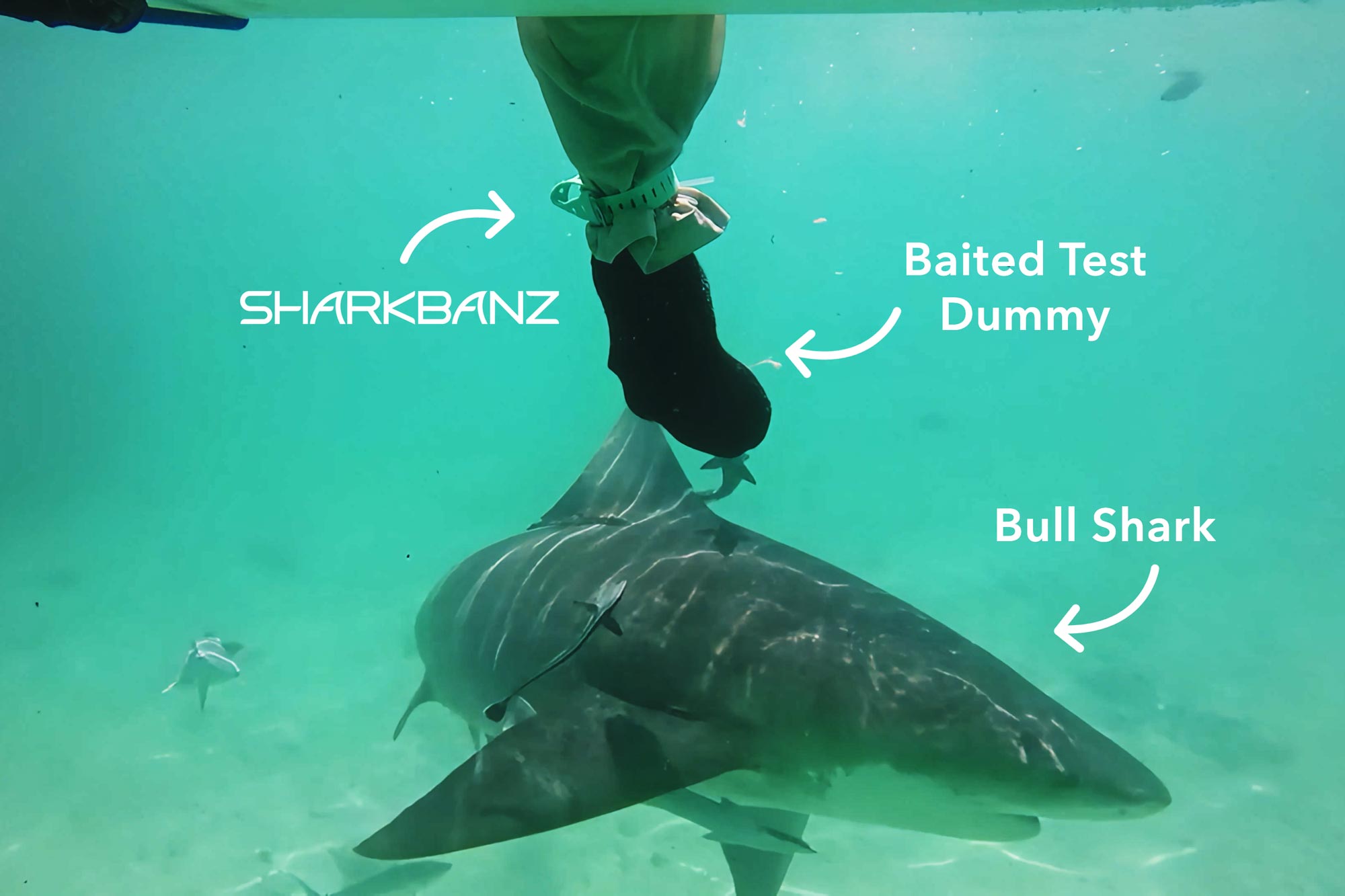
During a 2017 Bimini trial, researchers recorded 1,235 bull shark approaches over 2 hours and 38 minutes. Baited human-shaped models wearing Sharkbanz experienced zero attacks, while unprotected models were attacked approximately every 46 seconds.
The footage underwent independent analysis at Coastal Carolina University. According to Sharkbanz, researchers evaluated the recordings without knowing the company's conclusions, and their assessments differed by less than 1%.
The results demonstrate bull shark avoidance during repeated encounters under intense baited conditions. Bull sharks refused a baited, human-shaped target 1,235 times while wearing Sharkbanz, in a feeding scenario far more extreme than a swimmer or surfer creates. Sharkbanz's position is that avoidance under those conditions is the strongest available evidence for the wearable.
What Did Florida Atlantic University Find About Magnetic Deterrents?
A 2024 Florida Atlantic University (FAU) study tested the Sharkbanz Zeppelin against an identical non-magnetic dummy using baited underwater cameras off Jupiter, Florida. Within the device's effective range, the Zeppelin deterred approximately 22% of shark approaches, compared with 2.6% for the dummy, a statistically significant difference of more than eight times.
Researchers recorded 3,060 shark observations across four species during 20 hours of footage. The study examined whether the magnetic field could alter shark behavior around bait, providing evidence relevant to reducing shark depredation during fishing.
17. Bull sharks made 52 approaches to unprotected bait versus 19 to Zeppelin
Bull sharks approached the non-magnetic dummy 52 times, compared with 19 approaches to the Sharkbanz Zeppelin. They also bit the unprotected bait nine times, while recording zero bites on the magnet-protected bait.
Bull sharks have highly developed electroreceptive systems that detect weak electrical signals. These findings are consistent with the possibility that the Zeppelin's magnetic field influenced their approach and feeding behavior. However, the study's species-specific sample size limits broader conclusions about bull shark deterrence.
18. Zeppelin deterred 32.8% of sandbar shark approaches
Sandbar sharks were deterred during 32.8% of approaches to the Zeppelin, compared with just 4.2% for the non-magnetic dummy. The difference demonstrates how the presence of a permanent magnet can influence shark behavior during close-range feeding encounters.
Sandbar sharks provided the study's largest species-specific sample, allowing researchers to evaluate their response more reliably. Their avoidance behavior is particularly relevant to fishing deterrents because sandbar sharks are among the species involved in taking hooked fish.
19. Shark bite rates fell by approximately 49% with Zeppelin
The proportion of recorded bait interactions resulting in bites dropped from 7.4% with the dummy to 3.8% with the Sharkbanz Zeppelin. This represents an approximately 49% relative reduction under the study's testing conditions.
Sharks were still able to approach the bait, but fewer interactions resulted in bites when the magnetic deterrent was present. This suggests the Zeppelin can discourage some feeding attempts, even when sharks are attracted to a potential food source.
20. Approximately 75% of approaches showed no visible deterrent response
The FAU study found that approximately three-quarters of shark approaches within the device's effective range produced no visible avoidance response. Lemon sharks were largely unaffected, while other species, particularly sandbar sharks, showed stronger responses.
These differences reinforce that magnetic deterrence is not equally effective across every shark species or encounter. The study used baited rigs rather than live hooked fish, which may produce different behavioral responses because struggling prey generates additional sensory signals.
Despite these limitations, the Zeppelin produced significantly more avoidance responses than the non-magnetic control. The findings support its potential for reducing shark depredation, with further testing needed under live-fishing conditions.
Research disclosure: Sharkbanz supplied the devices, and the study was funded by the Colgan Foundation.
What About the 2018 Flinders University White Shark Study?
The 2018 Huveneers et al. study at Flinders University found that neither the Sharkbanz bracelet nor the Modom leash measurably affected white shark behavior toward baited boards. This finding requires context: the study tested devices attached to stationary surfboard replicas with tuna bait positioned approximately 30 to 40 cm away from and behind the deterrent, rather than between the shark and the bait as the product would be worn.
The same trial tested five products. Only the Ocean Guardian Freedom+ Surf, an electric device now off the market, reduced bait taken significantly (from 96% to 40%). Rpela, the electric surfboard deterrent, had no measurable effect under the same conditions, as did the two Sharkbanz products and Chillax Wax.
Sharkbanz had informed the researchers in advance that this placement would likely fail, given the magnetic field's limited effective range.
In a July 2024 interview with Stab magazine, Dr. Charlie Huveneers, Director of the Flinders Marine and Coastal Research Consortium, stated: "There's no doubt that magnets can deter sharks." He explained that the Sharkbanz "probably didn't do much in our tests" because of the 30 to 40 cm placement, and that all their tests used "extreme situations" with chum and bait.
Studies conducted after 2018, including the WA DPIRD trial, FAU research, and TAMU-CC thesis, reported positive deterrent findings under different testing conditions. The DPIRD and FAU studies documented positive effects for specific outcomes, while the TAMU-CC thesis reported encouraging preliminary results. The DPIRD study in particular used the device as Sharkbanz instructs for fishing applications.
The honest boundary
Sharkbanz does not claim to stop a high-speed white shark ambush attack. No product on Earth can. Research cited by Sharkbanz has documented magnetic deterrent responses in species including bull, sandbar, hammerhead, blacktip, reef, and juvenile tiger sharks, with effectiveness varying across species and testing conditions.
Choose Science-Backed Shark Deterrence With Sharkbanz
Shark deterrent research shows that magnetic technology can influence shark behavior, particularly among species such as bull, sandbar, and blacktip sharks. While no deterrent guarantees protection against every encounter, Sharkbanz offers a practical, battery-free approach supported by scientific research and field testing.
That research sits alongside twelve years of customer evidence: more than 200,000 users, 5,000+ five-star reviews through Shopper Approved with an average of about 4.8, 1,000+ reviews on the official Amazon listing, and hundreds of unsolicited shark-encounter reports since 2014.
Depending on the activity, Sharkbanz offers several options:
- Sharkbanz 2: A wearable magnetic deterrent designed for surfers, swimmers, and divers who want protection without batteries or charging.
- FCS x Sharkbanz POD: A surf-specific deterrent that attaches to compatible surf leashes for convenient use.
- Sharkbanz Zeppelin: A fishing-focused magnetic deterrent designed to help reduce shark depredation and protect hooked catches.
Sharkbanz technology requires no charging or ongoing battery maintenance, making it a convenient addition to responsible ocean safety practices.
Explore Sharkbanz shark deterrents today to find the right magnetic deterrent for your next ocean adventure.
Frequently Asked Questions
How does Sharkbanz magnetic technology deter sharks?
Sharks have specialized electroreceptive organs called ampullae of Lorenzini that detect weak electric fields. Sharkbanz uses a patented permanent magnet that creates a magnetic field that overwhelms this sense. Marine biologists describe the effect as equivalent to a bright light shining in your eyes in a dark room. The field is effective within 3-6 feet of the device and affects only sharks and rays, not bony fish.
Are Sharkbanz products proven effective against Great White Sharks?
Sharkbanz does not claim to stop high-speed white shark ambush attacks, and no product can. The 2018 Flinders study found no measurable effect on white sharks, though the lead researcher later noted the test setup placed devices 30-40 cm from bait rather than between shark and target. Sharkbanz cites research demonstrating magnetic deterrent responses across species including bull, sandbar, hammerhead, blacktip, and reef sharks, alongside product testing involving juvenile tiger sharks. Effectiveness varies by species, testing conditions, and encounter behavior. Published research from South Africa showed that white sharks are sensitive to permanent magnets and that they displayed notable avoidance behavior toward magnets in the experiments using magnetic barriers. As summarised by Shark Angels: “Over the forty-nine trials, a total of forty-four different white sharks were identified. The data collected from this study showed a strong behavioral distinction between treatment and control types. The control regions were entered by white sharks 256 times, while both the procedural control and magnetic regions were entered an impressive 0 times. To validate the data, the researchers analyzed the data in a second way, and found the magnetic regions yielded the only significant results, meaning the data collected was too strong to be due to chance. The researchers also observed native fish species swimming through the magnetic regions with no change in their behavior, proving the barrier repels white sharks but not other sea life”.
Do Sharkbanz products require batteries or charging?
No. All Sharkbanz wearable products use permanent magnet technology requiring zero batteries and zero charging. The deterrent field is always active when the device is in water. This contrasts with electric deterrents that require regular charging and can fail if batteries deplete.
What is the effective range of Sharkbanz deterrents?
Sharkbanz technology creates an approximate deterrent field of 3-6 feet (1-2 meters) per unit. In FAU testing of the Zeppelin, magnetic field strength exceeded 400 microtesla at the device, approximately 10x Earth's magnetic field at the study site. The field dissipates with the inverse cube of distance, becoming imperceptible to sharks beyond a few meters.
Can Sharkbanz products be used for both surfing and fishing?
Yes. The Sharkbanz 2 is designed for surfers, swimmers, and divers, while the FCS x Sharkbanz POD attaches to surf leashes. The Zeppelin is specifically engineered for fishing applications. For bottom fishing, Sharkbanz recommends positioning it inline 18-36 inches from the hooked fish's tail. It can also attach to fish bags, stringers, or other equipment for wade fishing and spearfishing.