


Shark encounters remain a concern for anyone who spends time in the ocean, from recreational surfers and swimmers to professional divers and anglers. The International Shark Attack File recorded 65 unprovoked bites worldwide in 2025, with the United States and Australia accounting for most incidents. While shark attacks are statistically rare, the consequences can be severe, and many ocean users now consider personal protection as part of their safety routine.
Think of shark deterrents the way you think about seatbelts. Seatbelts cut front-seat fatality risk by about 45%, yet nobody calls them useless because they do not prevent every death. A shark deterrent works within a broader safety approach: check conditions and signs, avoid dawn and dusk, stay away from murky water and river mouths, keep clear of bait schools and fishing activity, stay in groups, and wear a deterrent when appropriate.
The Sharkbanz 2 wearable deterrent represents the leading option in this category, backed by over two decades of research on magnetic shark deterrent technology.
Key Takeaways
- Magnetic shark deterrents offer battery-free, always-on protection and represent the most practical choice for everyday ocean users including surfers, swimmers, divers, and families.
- The Sharkbanz product line covers three use cases: the Sharkbanz 2 wearable for general water activities, the FCS x Sharkbanz POD for surfers, and the Zeppelin for anglers.
- Electric deterrents such as Rpela serve a different customer: surfers at the highest-risk breaks who are willing to fit a device to their board, charge it before every session, and pay more for it.
- Visual deterrents and protective wetsuits serve as complementary layers rather than standalone solutions.
- Chinese counterfeit shark deterrent bands sold on Amazon lack the necessary components to actually deter a shark and should be avoided.
What Should You Look for in a Shark Deterrent?
The right shark deterrent depends on your activities, budget, and how much maintenance you want to handle. A strong deterrent should reduce the likelihood of unwanted shark encounters without creating friction in your routine.
Key evaluation criteria include:
- Technology type: Magnetic deterrents require no power and stay active whenever submerged. Electric deterrents create larger fields but need charging and often shock the wearer.
- Proven research: Look for peer-reviewed studies or independent government testing, not just manufacturer claims.
- Species coverage: Different technologies work better against different species. Peer-reviewed research documents avoidance in bull, sandbar, hammerhead, and blacktip sharks, and Sharkbanz product testing adds juvenile tiger sharks. No product can stop a high-speed white shark ambush attack.
- Power requirements: Battery-free devices eliminate the risk of forgetting to charge before a session and all the maintenance associated.
- Depth rating and durability: Divers and spearfishers need products rated for their typical depths.
- Price and replacement cycle: Consider total cost of ownership including accessories and recommended replacement intervals.
No shark deterrent guarantees complete protection. The goal is risk reduction as part of a holistic safety approach.
How Does Magnetic Shark Deterrent Technology Work?
Magnetic shark deterrents target the ampullae of Lorenzini, specialized electroreceptive organs that sharks use to detect weak electric fields within a couple meters. Sharkbanz uses powerful permanent magnets to create a localized magnetic field. As a shark moves through this field, electromagnetic induction generates an electrical signal that its ampullae of Lorenzini can detect. This unusually strong signal can startle the shark and cause it to turn away, similar to a bright light suddenly shining in someone's eyes in a dark room.
The technology draws on over 20 years of peer-reviewed research across multiple universities and government agencies. Studies have documented avoidance behavior in bull sharks, sandbar sharks, hammerheads, blacktips, grey reef sharks, great white sharks, and other species. The effective range typically spans 3 to 6 feet per device, and the field weakens rapidly with distance, limiting its deterrent effect to the immediate vicinity of the device.
Due to the physics behind this magnetic technology, it’s impossible for sharks to be attracted to the device from a distance.
Sharkbanz states that its technology does not affect marine life without the relevant electroreceptive organs. Only sharks and rays can detect the field emitted by Sharkbanz devices. However, the magnets should be kept away from sensitive electronics.
Recent independent research supports the technology when devices are positioned correctly:
- The Western Australia DPIRD study found that shark deterrent devices, including the Sharkbanz Zeppelin, reduced the probability of fish being taken by sharks by 65% overall during recreational fishing trials, with depredation falling from 40% of hooked fish to as low as 12% depending on the device.
- A Florida Atlantic University thesis recorded 21.7% deterrence versus 2.6% for a non-magnetic control using baited fishing rigs, with bull sharks biting the control bait 9 times and the magnet-protected bait zero times. The peer reviewed research paper will be published before the end of 2026.
- A Texas A&M University-Corpus Christi master's thesis seminar ran 41 recreational reef-fishing trips with active and inactive Zeppelins. Sharks caused 88% of identified depredation events, every one of them on the inactive device; the active Zeppelin recorded zero shark depredation events, and catch rates for target species did not change. These findings will be published in an official peer reviewed research paper in early 2027.
1) Sharkbanz 2
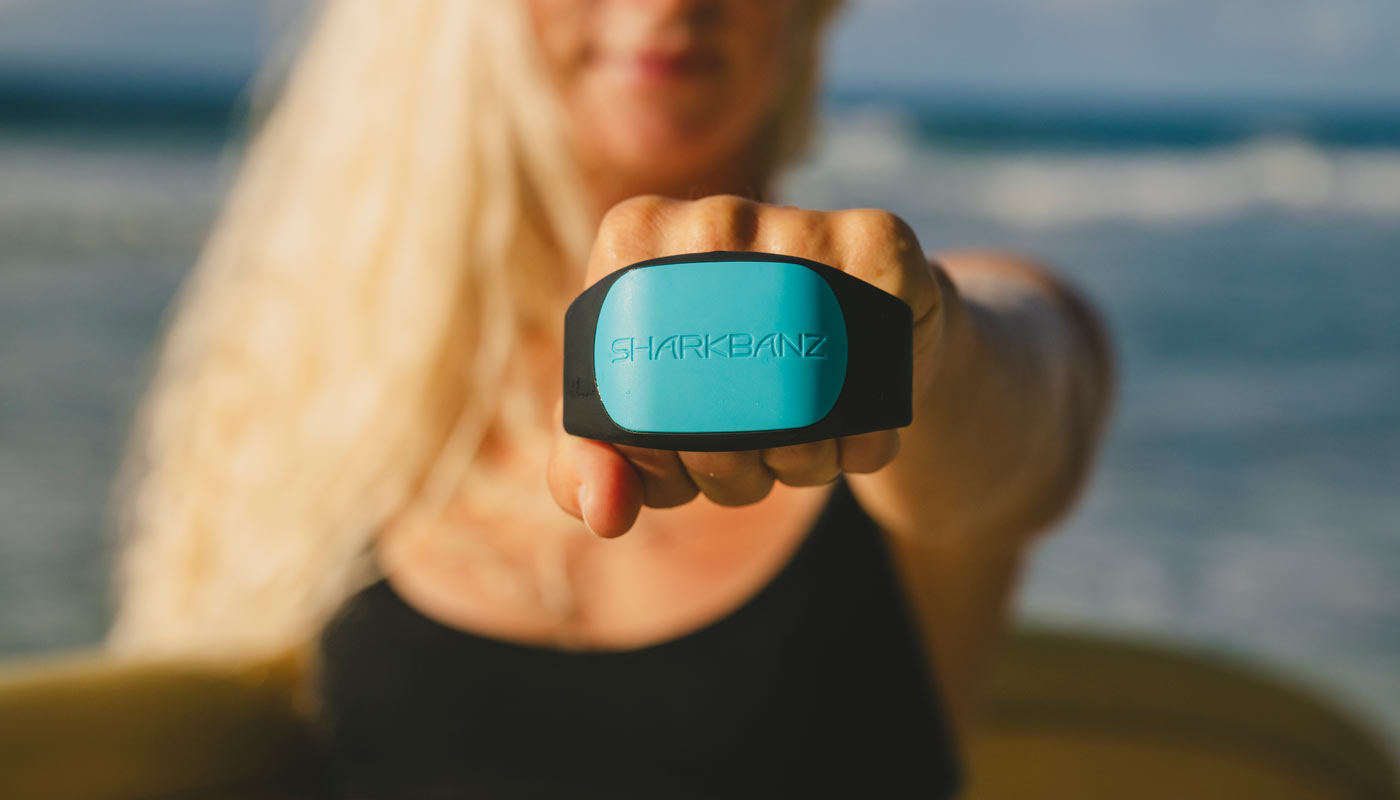
The Sharkbanz 2 is the flagship wearable deterrent from the company that pioneered magnetic shark deterrent technology for personal use. Worn on the ankle or wrist, it serves surfers, swimmers, divers, snorkelers, wade fishermen, open water swimmers, and families at the beach.
Why It Fits Most Ocean Users
The Sharkbanz 2 addresses the widest range of water activities in a single device. It requires no batteries, no charging, and no activation. The patented magnetic core is always active, making it the always-on layer for anyone entering the ocean.
Key Features
- Patented permanent magnet technology with 3–6 foot effective range
- No batteries or charging required
- 100-meter (330-foot) depth rating
- Weighs 3-ounces with adjustable silicone band
- Proven to deter sharks and stingrays
- 3-year warranty with recommended replacement every 4 years
- TSA and airline travel-friendly
- Available in 7 colorways including Bethany Hamilton signature editions
Supporting Evidence
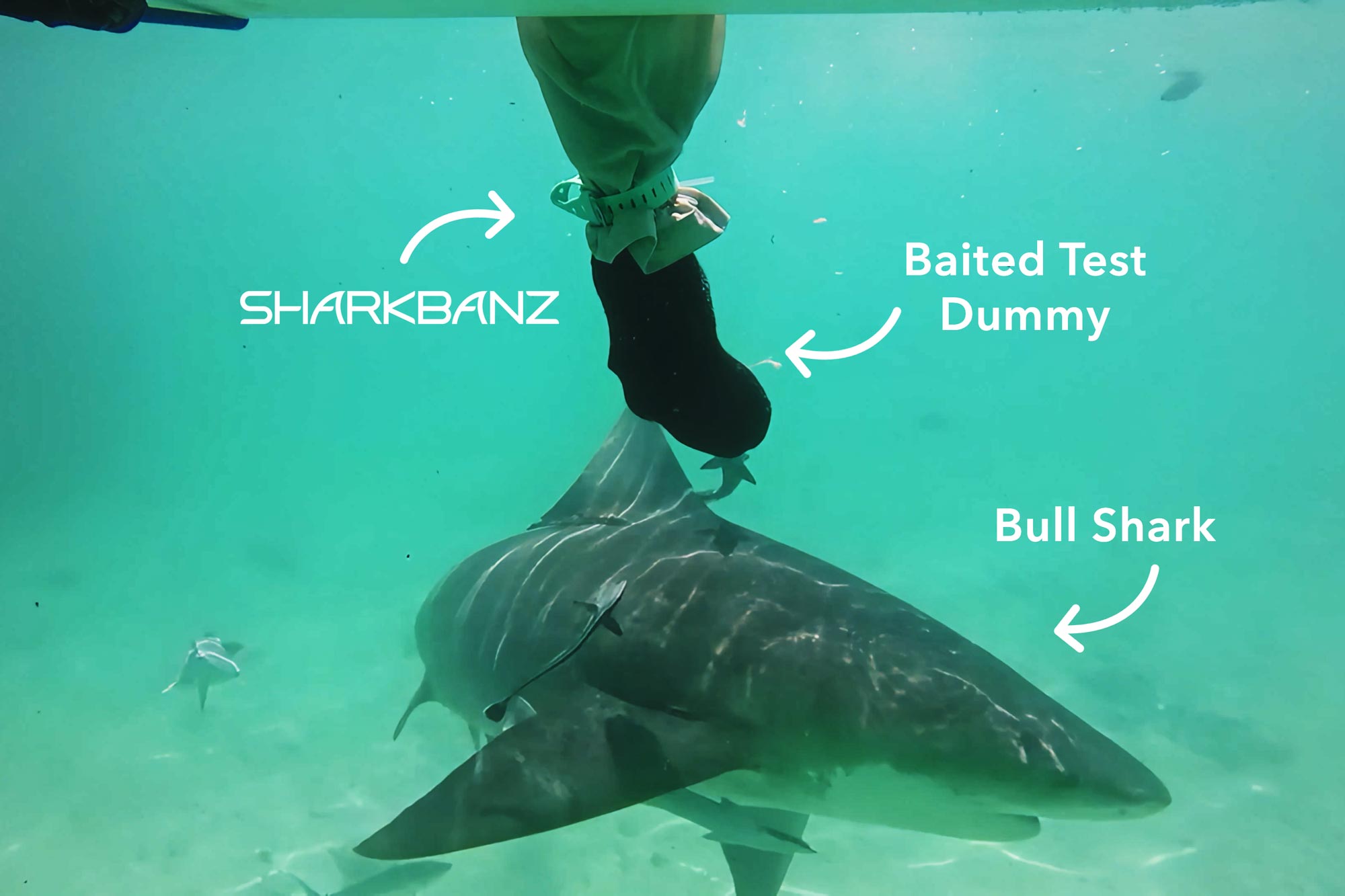
A 2017 bull shark trial conducted in Bimini, Bahamas in collaboration with Discovery Channel Canada documented 1,235 bull shark approaches over 2 hours and 38 minutes using baited human-form models. Models equipped with Sharkbanz experienced zero attacks during treatment trials, while control models without bands were attacked on average every 46 seconds.
The results underwent an independent Coastal Carolina analysis. The raw footage was submitted to the researchers for review with no implicit bias or reveal of what the Sharkbanz team found. The researchers used the same evaluation criteria to define avoidance behavior. On completion, the Coastal Carolina researchers and the Sharkbanz scientific team had less than 1% variation in their report. These findings reflect controlled, baited testing conditions - an extreme scenario far beyond what an ocean goer would encounter in the wild.
Price: $138
2) FCS x Sharkbanz POD
The FCS x Sharkbanz POD represents a collaboration between Sharkbanz and FCS, the surf industry's leading fin and leash manufacturer. It uses the same patented magnetic deterrent technology as the Sharkbanz 2 but is engineered specifically for surfers.
Why It Fits Surfers
The POD attaches discreetly to any surf leash cuff via a neoprene pouch with velcro strap. Surfers who prefer not to wear a band on their ankle or wrist can mount the deterrent on equipment they already use. The collaboration with FCS signals mainstream surf industry acceptance of deterrent technology.
Key Features
- Same patented magnetic technology as Sharkbanz 2
- Attaches to any surf leash or stashes in boardshorts pocket or wetsuit key pocket
- 2-ounce weight
- Neoprene pouch with low-profile padding and molded Velcro attachment
- Works for surfing, paddle boarding, bodyboarding, windsurfing, kitesurfing, and foiling
- Replacement pouch available separately for $12
Why This Price Point Works
At $120, the POD costs less than the Sharkbanz 2 while using the same patented magnetic deterrent technology in a surf-specific design. The POD offers surfers a more affordable option with a convenient leash-mounted attachment system.
Price: $120
3) Zeppelin Fishing Deterrent
The Zeppelin is the world's first shark deterrent fishing tackle, designed to protect catch from shark depredation during bottom fishing, wade fishing, and spearfishing.
Why It Fits Anglers
Shark depredation costs recreational anglers significant catch. A survey of 541 US saltwater anglers found 77% lost a fish to a shark in the past five years, with over half reporting more than 20 events. The Zeppelin addresses this by creating a deterrent field around hooked fish.
Key Features
- Same patented magnetic technology as wearable products
- 6.5-ounce weight replaces or supplements sinker in fishing rigs
- Biodegradable PLA construction
- Three rigging methods: inline attachment, deployment after hookup, or attachment to fish bags and stringers
- Does not deter target fish species
- Winner of ICAST 2021 Best Terminal Tackle
- 1-year warranty
Government Validation
The Western Australia DPIRD study found that the Sharkbanz Sentry, now sold as Zeppelin, reduced shark depredation during recreational fishing trials. The study found that shark deterrents reduced depredation probability by 65% across the three devices tested, including Sharkbanz.
Underwater footage also documented sharks displaying avoidance behavior around the Sharkbanz device. The study involved baited fishing lines in waters inhabited by several shark species, including whaler sharks, and was funded through recreational fishing licence fees.
These findings demonstrate reduced shark depredation during fishing and strong avoidance behavior in response to the permanent magnets used in Sharkbanz products. This research is also relevant to Sharkbanz's wearable deterrents, which use the same magnetic technology. Observing sharks turn away from hooked fish shows how the technology can influence shark behavior even during active feeding encounters.
Fisheries Minister Don Punch noted that deterrents do not prevent every shark from taking a fish, but they help anglers land more of their catch.
Price: $69.99
4) Rpela
Rpela is an Australian electric deterrent fitted to the surfboard rather than worn. Its current model, the RPELA V2 Pro, is a 155-gram, water-activated unit with a USB fast-charge battery.
It sells for AU$449 with a housing kit for a DIY install on standard polyester boards between 5'10" and 7'6". It is not suitable for softboards or plastic boards, and the electrodes need periodic cleaning.
Where It Fits
Rpela serves a different customer from Sharkbanz: the surfer at a known high-risk break who wants a board-integrated electric field and is willing to manage charging and maintenance. Sharkbanz has recommended electric devices for exactly that use case. For the broader population of recreational surfers, swimmers, divers, and anglers, a battery-free magnetic deterrent is the most convenient and affordable option.
Key Features
- Pulsed electric field from board-mounted electrodes
- Fitted to the board; one unit can be moved between boards
- Water-activated, USB fast-charge
- Must be charged before each session; electrodes need cleaning
- Not for softboards or plastic boards
What to Consider
Rpela reports a 66% reduction in bite probability across 46 controlled trials of the RPELA V2, analysed independently; that figure is the company's own.
5) Shark Eyes
Shark Eyes are visual deterrent decals that stick to the underside of surfboards and other equipment. Founded by big wave surfer Shanan Worrall, they are the most affordable entry point to shark deterrent products.
Where It Fits
Shark Eyes work as a complementary layer alongside active deterrents. The eye spot pattern mimics a defense mechanism seen throughout nature, where predators avoid prey displaying prominent eye markings.
Key Features
- Eye decals for boards and underwater equipment
- Universal application
- Works at all depths (visual range dependent)
- No batteries or maintenance
- Biomimicry approach based on eye spots found in nature
What to Consider
Visual deterrents lack the peer-reviewed research supporting magnetic and electric technologies. They serve best as an additional layer paired with proven deterrent methods rather than a standalone solution.
6) IronSkinn Wetsuits
IronSkinn produces shark bite-resistant wetsuits tested against great white and bull sharks. Rather than deterring sharks, these wetsuits aim to reduce injury severity if a bite occurs.
Where It Fits
IronSkinn addresses a different problem than deterrents. It suits users who want physical protection as a last line of defense, particularly in extremely high-risk environments or professional applications.
Key Features
- Shark bite-resistant fabric
- 5mm thickness, non-thermal
- UPF 50+ sun protection
- Tested against great white and bull sharks
- Elastic, form-fitting design for mobility
- 7kg weight for XL size
What to Consider
IronSkinn sells its shark-resistant suits on enquiry rather than off the shelf, and its commercial dive armor lists at US$8,999. The weight and cost suit professional users rather than recreational swimmers or surfers. Pairing protective gear with a deterrent device creates a layered approach.
7) SAMS Radiator Diverter Wetsuit
SAMS (Shark Attack Mitigation Systems) developed visual camouflage technology for wetsuits, including the Diverter design, which uses contrasting patterns to disrupt a shark's ability to recognize a swimmer's silhouette as potential prey. The technology aims to reduce visual recognition rather than physically repel sharks.
Where It Fits
Visual deterrent wetsuits appeal to users who want passive protection without electronics. The biomimicry approach draws on research into shark color blindness and visual predation patterns.
Key Features
- Contrasting striped patterns designed to disrupt the wearer's silhouette underwater
- Comfortable, flexible wetsuit material
- No electronics or batteries
- Can pair with board stickers for full visual deterrent coverage
What to Consider
Peer-reviewed field testing of visual-pattern wetsuits is limited compared with the research behind magnetic and electric fields. The SAMS website is currently offline, and the Diverter design is sold through Radiator Waterwear, so check availability before buying. Visual approaches work best as a supplement to proven deterrent technology.
How Can You Spot Counterfeit Shark Deterrent Bands on Amazon?
Multiple sellers on Amazon offer low-cost "shark deterrent bands" that lack proven shark deterrent technology. Sharkbanz reports that the counterfeit products it tested typically did not contain even basic magnets. These counterfeits copy the visual design of legitimate products while delivering no protection.
Warning signs of counterfeit products include:
- Price significantly below $100 for a wearable band: Counterfeit bands are listed on Amazon for $18 to $95. The genuine Sharkbanz 2 uses the patented permanent-magnet technology and sells for $138, and Sharkbanz identifies unusually low prices as a warning sign of counterfeits.
- No research citations: Authentic products link to peer-reviewed studies and independent testing.
- Generic product descriptions: Counterfeits often use vague language without specific technology explanations.
- Missing brand verification: The authentic Sharkbanz listing on Amazon carries the brand name and has over 1,000 reviews.
- No warranty information: Genuine Sharkbanz products carry warranties covering manufacturing defects, with 3 years for Sharkbanz 2 and 1 year for the Fishing Zeppelin and FCS x Sharkbanz POD.
Purchase directly from sharkbanz.com or authorized retailers listed on the Sharkbanz website. For Amazon purchases, verify the seller's authenticity with Sharkbanz.
Why Does Sharkbanz Stand Out Among Shark Deterrents?
Sharkbanz has established itself as the leading choice in personal shark deterrent technology for several reasons that matter to ocean users choosing a safety device.
- Independent government validation: The Western Australia DPIRD conducted 2-year field studies demonstrating that Sharkbanz technology can help fishermen land more fish by reducing shark depredation. This government testing, funded by recreational fishing licence fees, provides third-party verification beyond manufacturer claims.
- Twelve years of customer evidence: Sharkbanz has been in market since 2014 and reports more than 200,000 users worldwide, 5,000+ five-star reviews through Shopper Approved with a product average of about 4.8, 1,000+ reviews on the official Amazon listing, and hundreds of unsolicited shark-encounter reports from customers. It is sold through 300+ retail doors including Bass Pro Shops, Divers Direct, and Adreno, and is the safety partner of the Eastern Surfing Association, Surfing Queensland, Barton Lynch’s Blast Off and Swim Miami.
- Always-on protection: The patented permanent magnet technology requires zero batteries and zero charging. Every time you enter the water, the deterrent is active. Electric alternatives require users to remember to charge before sessions and manage additional equipment.
- Proven across species: Testing has documented avoidance behavior in 10+ predatory shark species including bull sharks, tiger sharks, hammerheads, blacktips, sandbar sharks, grey reef sharks, and others. The technology can also deter stingrays, providing an additional benefit for wade fishermen.
- Product range for every use case: The Sharkbanz 2 covers general water activities, the POD serves surfers, and the Zeppelin protects anglers. This range means users can select the right form factor for their activities rather than compromising on a one-size-fits-all solution.
- Transparent limitations: Sharkbanz openly states that no product can stop a high-speed white shark ambush. This honesty about limitations, combined with strong evidence for investigatory encounters across other species, builds credibility that marketing-heavy competitors cannot match.
Choose Sharkbanz for Reliable, Battery-Free Shark Deterrence
The best shark deterrent fits your ocean activities, requires minimal maintenance, and is supported by credible research. While no device can guarantee protection against shark encounters, Sharkbanz offers a practical, battery-free solution backed by over two decades of research into magnetic deterrent technology.
Sharkbanz provides purpose-built options for different ocean users:
- Sharkbanz 2: A wearable magnetic deterrent for surfers, swimmers, divers, and recreational ocean users, requiring no batteries or charging.
- FCS x Sharkbanz POD: A compact, leash-mounted deterrent designed for surfers who prefer integrating protection into their existing equipment.
- Sharkbanz Zeppelin: A magnetic deterrent for anglers looking to reduce shark depredation and protect hooked fish.
Unlike battery-powered alternatives, Sharkbanz devices remain active without charging or activation. Their patented magnetic technology also offers a convenient addition to responsible ocean safety practices.
Ready to add an extra layer of protection to your ocean activities? Explore Sharkbanz deterrents and find the right solution for your needs.
Frequently Asked Questions
How do magnetic shark deterrents work?
Sharkbanz products consist of powerful permanent magnets that produce a magnetic field in the sea water around the unit. Sharks are not truly magneto receptive - they do not have an actual magneto receptive organ in the body. However, they are able to take advantage of the interaction of electric and magnetic fields to detect magnetic fields indirectly with their electroreceptors. They do this by a process known as electromagnetic induction. If you move a particle through a magnetic field you will induce an electric field orthogonal to the direction of travel. Imagine a shark swimming from east to west along the equator. It will be passing through the earth's magnetic field that runs from the south pole to the north pole. As the shark swims through the magnetic field, it will induce an electric field around itself that is detectable by the electro receptors in its head. Therefore, the shark is not directly detecting the magnetic field, rather it is detecting the electric field that is induced by moving through the magnetic field.
For the Sharkbanz, there is a strong local magnetic field that produces a magnetic anomaly. A shark moving past this strong magnet will sense a large electric field which is well beyond the range of anything that it would naturally encounter in the wild. As a result, the shark can be startled by the strong electric field and swim away. The shark needs to be moving with respect to the magnet in order for there to be a detectable electric field produced. In theory, if you were to securely affix a Sharkbanz directly to the head of the shark, the shark would not be able to detect the magnet on its head.
The magnet itself is not something that the shark can detect, the shark can only detect the electric field that is produced when it moves with respect to the magnetic field, or when the Sharkbanz moves in respect to the shark. The sensation is comparable to a bright light in a dark room, causing sharks to turn away. The field extends approximately 3–6 feet from the device. The range is variable based on the movement of the device and the movement of the shark. It does not harm sharks or other marine life. However, the magnets can interfere with compasses and sensitive electronics.
Are shark deterrents scientifically proven to work?
Yes, research has demonstrated deterrent effects for magnetic technology under specific testing conditions. The FAU 2024 master's thesis found Sharkbanz Zeppelin deterred 21.7% of approaches versus 2.6% for a non-magnetic control on baited camera rigs, with bull sharks showing zero bites on the protected bait versus 9 on the control. Sharkbanz supplied the devices, and the study was funded by the Colgan Foundation. The WA DPIRD study found a 65% reduction in depredation probability across three tested deterrent devices, including the Sharkbanz Sentry, now sold as Zeppelin. New research out of Texas A&M University-Corpus Christi’s Harte Research Institute showed strong results for Sharkbanz’ product. In a thesis defended June 26, 2026, at the Harte Research Institute, marine biology graduate student Kyle D. King tested the Sharkbanz Zeppelin, a magnetic shark deterrent, in Gulf of America recreational reef fish fisheries. His advisor was Dr. Daniel Coffey, with Dr. Kesley Gibson Banks and Dr. Shawn McCracken on the committee. The headline result: not a single shark depredation event was recorded while an active deterrent was deployed.
Which shark species respond to magnetic deterrents?
Peer-reviewed research has documented avoidance behavior to permanent magnets in bull sharks, white sharks, whaler sharks, sandbar sharks, great and scalloped hammerheads, blacktips, Australian blacktips, grey reef sharks, milk sharks, speartooth sharks, and juvenile tiger sharks. Lemon sharks responded in earlier laboratory work but were largely unaffected in the 2024 FAU field study, which also tested silky sharks. No product can stop a high-speed white shark ambush, though investigative encounters may be affected.
Do shark deterrents require batteries or charging?
Magnetic deterrents like Sharkbanz products require no batteries or charging. The patented permanent magnet technology stays active whenever submerged. Electric deterrents like Rpela require regular charging between sessions.
Can I use a shark deterrent for fishing?
Yes. The Zeppelin fishing deterrent is designed specifically for bottom fishing, wade fishing, and spearfishing. It can be rigged inline, deployed after hookup, or attached to fish bags and stringers. Government testing confirmed anglers land more fish with reduced shark depredation.