


The shark deterrent market offers different technologies designed to reduce the risk of shark encounters, with magnetic and electric deterrents among the options available. For ocean users, understanding how these technologies work, what scientific research supports them, and where their limitations lie is essential to making an informed choice.
For swimmers, surfers, divers, and fishermen weighing their choices, the comparison between magnetic and electric shark deterrents comes down to scientific evidence, practical convenience, price, and honest limitations. The Sharkbanz 2 wearable deterrent represents the magnetic approach, using permanent magnet technology that requires no batteries or charging, while electric deterrents like Rpela generate active electrical pulses but require regular charging and typically involve higher upfront costs.
This article examines what the research actually shows, where each technology excels, and what questions remain unanswered so you can make an informed decision about shark safety in 2027.
Key Takeaways
- Magnetic deterrents use permanent magnets to create a magnetic field that stimulates sharks' electroreceptive organs (ampullae of Lorenzini) through electromagnetic induction, while electric deterrents generate active electrical pulses requiring batteries
- Western Australia's government-funded DPIRD fishing study found that three tested deterrent devices, including the Sharkbanz Sentry (now sold as Zeppelin), collectively reduced shark depredation by approximately 65% during recreational fishing trials
- Florida Atlantic University's December 2024 master's thesis found the Sharkbanz Zeppelin deterred 21.7% of in-range approaches versus 2.6% for a non-magnetic control during baited-camera trials off Jupiter, Florida, with bull sharks biting the protected bait zero times versus nine on the control
- Sharkbanz magnetic deterrents cost $69.99-138 and require no batteries or charging, although Sharkbanz recommends replacing the Sharkbanz 2 every four years; electric options require charging and may involve battery replacement and electrode maintenance
- No shark deterrent guarantees complete protection; think of these devices like seatbelts, which reduce fatality risk but cannot prevent every accident
How Do Magnetic and Electric Shark Deterrents Actually Work?
Both technologies target the same biological system but through different mechanisms. Sharks possess electroreceptive organs called ampullae of Lorenzini, which detect weak electrical fields within a couple of meters.
These sensors help sharks locate prey, navigate using Earth's magnetic field, and detect the bioelectric signatures of living creatures.
Magnetic Deterrents
They use permanent magnets to create a static magnetic field. As a shark moves through this field, electromagnetic induction can stimulate its ampullae of Lorenzini, triggering avoidance behavior. Marine biologists describe the sensation as equivalent to a bright light in your eyes in a dark room.
The magnetic field drops off with the inverse cube of distance, weakening rapidly beyond the device, so it cannot attract sharks. Sharkbanz states that its technology is designed to selectively deter sharks and rays through their electroreceptive systems without affecting other marine animals.
Electric Deterrents
They generate active electrical pulses through battery-powered electrodes. These pulses directly stimulate the shark's electroreceptors, creating artificial "electrical noise" that can cause discomfort or confusion. The active field requires constant power, which means battery management becomes essential.
The fundamental tradeoff: magnetic technology is always-on with no charging required, while electric technology produces an active pulsed field that depends on battery charge, electrode condition, and a board install. Electrical deterrents are the most powerful but the least convenient.
What Does the Scientific Research Actually Show?
The evidence base for shark deterrents includes both independent peer-reviewed studies and company-funded research. Understanding who conducted each study and under what conditions matters for interpreting results.
The 2018 Flinders University Study
The most-cited research on shark deterrents comes from Huveneers et al. (2018), published in PeerJ. The study tested five deterrent products against white sharks at Neptune Islands, South Australia.
The published finding
Neither the Sharkbanz bracelet nor the Modom leash (a Sharkbanz-licensed product) measurably affected white shark behavior toward baited boards. Rpela, the electric surfboard deterrent, and Chillax Wax also showed no measurable effects under the same conditions. The Ocean Guardian Freedom+ Surf electric deterrent, now off the market, was the only product that significantly reduced the percentage of bait taken or touched, from 96% to 40%.
The setup context
The study tested white sharks using stationary surfboard replicas with tuna bait positioned approximately 30 to 40 cm away from and behind the magnetic deterrents, rather than placing the deterrents directly between the shark and the bait as the product would be worn. This distinction matters because magnetic deterrents operate within a limited effective range.
Sharkbanz had informed the researchers in advance that this placement would likely be ineffective. The company has maintained that the testing arrangement did not reflect the devices' intended use.
What the lead scientist said later
In a July 2024 Stab magazine interview, Dr. Charlie Huveneers, Director of the Flinders Marine and Coastal Research Consortium, stated: "There's no doubt that magnets can deter sharks." He explained that Sharkbanz "probably didn't do much in our tests" because of the 30 to 40 cm placement and acknowledged that the tests involved "extreme situations" using chum and bait.
Subsequent research, including the WA DPIRD trial, FAU research, and TAMU-CC thesis, reported positive magnetic deterrent findings under different testing conditions. The DPIRD and FAU studies documented positive effects for specific outcomes, while the TAMU-CC thesis reported encouraging preliminary results. The DPIRD trial also tested the device in a configuration consistent with Sharkbanz's fishing-use instructions.
The honest boundary
Sharkbanz does not claim to stop a high-speed white shark ambush attack, and no shark deterrent can guarantee protection against every encounter. Research cited by Sharkbanz has documented magnetic deterrent responses in species including bull, sandbar, hammerhead, blacktip, reef, and juvenile tiger sharks, with effectiveness varying across species and testing conditions.
Government and University-Funded Studies with Correct Placement
Subsequent research conducted with devices positioned as designed has documented different results.
Western Australia DPIRD Study (2020–2021)
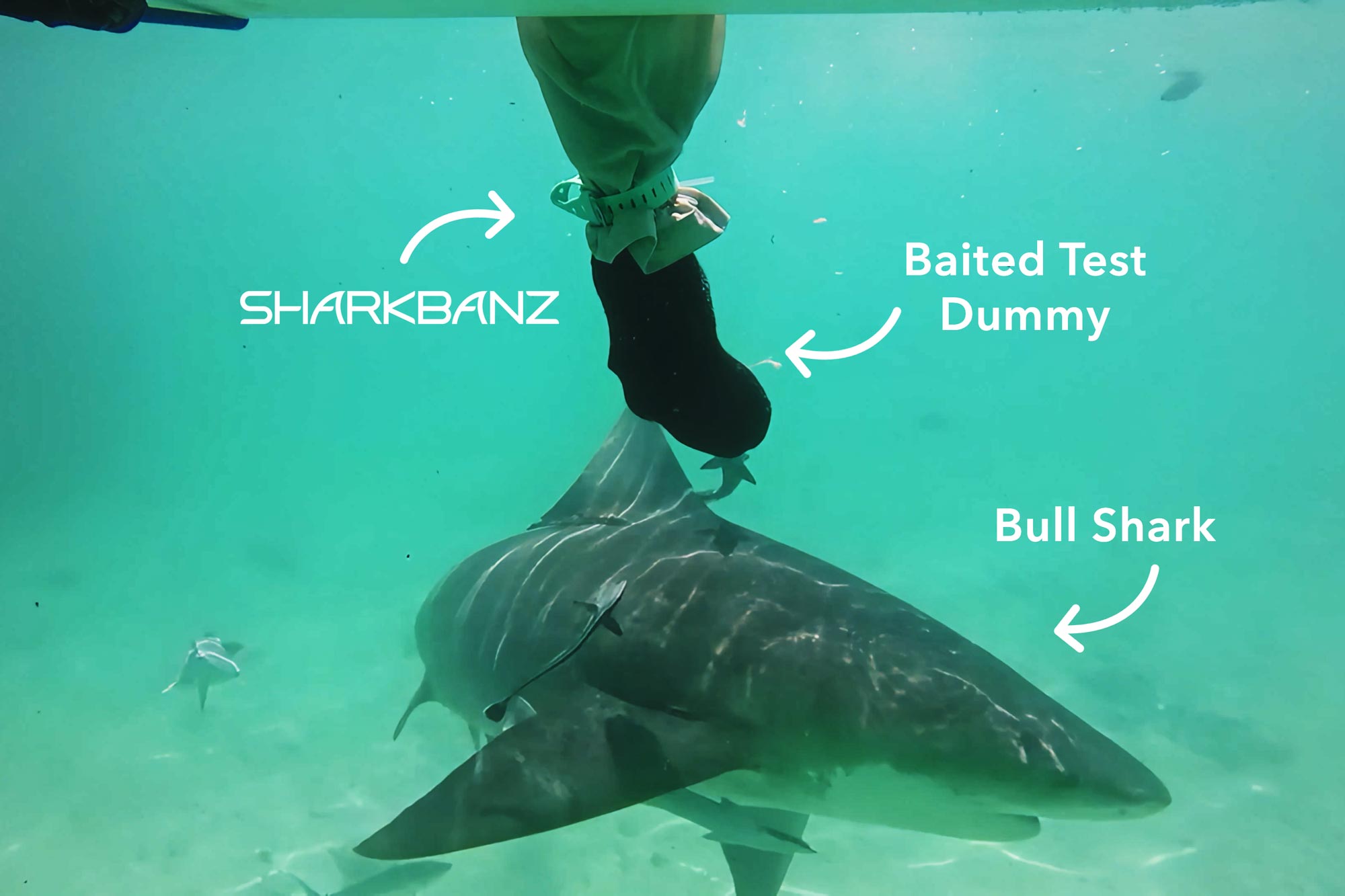
This government-funded trial tested deterrents in recreational line fisheries at Montebello Islands and Exmouth. With GoPro cameras monitoring approximately 180 hours of footage across 60 sites, the results showed that the tested deterrents, including the Sharkbanz Sentry (now sold as the Zeppelin), collectively reduced the probability of shark depredation by approximately 65%.
Funded by recreational fishing license fees through the Recreational Fishing Initiatives Fund, this represents independent government validation of the tested deterrent technologies.
Florida Atlantic University Study (2024)
Laura Jones' research from the Kajiura ElasmoLab tested the Sharkbanz Zeppelin against non-magnetic control devices on baited camera rigs off Jupiter, Florida. The research involved four shark species: silky, sandbar, bull, and lemon sharks.
The December 2024 FAU thesis found that the Sharkbanz Zeppelin deterred sharks on 21.7% of approaches within its effective range, compared with 2.6% for non-magnetic control devices. The baited-camera trials involved silky, sandbar, bull, and lemon sharks off Jupiter, Florida. Sharkbanz supplied the devices, and the Colgan Foundation funded the research. This research is also relevant to Sharkbanz's wearable deterrents, which use the same magnetic technology. Sharks turning away from baited rigs shows how the technology can influence shark behavior even during active feeding encounters.
The research also highlights the importance of evaluating magnetic deterrents under different conditions, including fishing scenarios involving live, struggling hooked fish.
Species Where Evidence Is Strongest
Research on Sharkbanz products and magnetic deterrent technology has documented avoidance responses across multiple shark species, although the strength of evidence varies by species and testing conditions:
- Bull sharks: Documented behavioral responses in magnetic deterrent testing and barrier studies, with separate magnetic-barrier research reporting no bull shark crossings in 114 trials
- Sandbar sharks: Avoidance documented by Siegenthaler et al. (2016, Journal of Fish Biology), and in the 2024 FAU field study, where sandbar sharks were deterred 32.8% of the time with the Zeppelin versus 4.2% with the dummy
- Hammerheads (Great and Scalloped): Responses documented by Rigg et al. (2009, Marine and Freshwater Research) in Australian species
- Tiger sharks: Sharkbanz reports positive deterrent responses in testing with juvenile tiger sharks and has also received customer testimonials involving larger tiger sharks. Controlled evidence for adult tiger sharks remains more limited.
- Blacktips, reef sharks, milk sharks, speartooth sharks: Documented in Australian species research
The honest limitation: No product can reliably stop a high-speed ambush attack from a white shark. Sharkbanz does not claim otherwise. White sharks matter most where they hunt surfers: ISAF 2025 data attributes three of the nine unprovoked fatalities to white sharks biting surfers in Australia.
Bite statistics describe where and how encounters happen; they do not establish the effectiveness of any individual deterrent.
How Do Practicality and User Experience Compare?
Beyond effectiveness claims, the daily experience of using each technology differs substantially.
Magnetic Deterrents: The "Always-On" Advantage
The Sharkbanz 2 and FCS x Sharkbanz POD share core practical benefits:
- Zero batteries or charging: The permanent magnet generates its field continuously with no power source
- No pre-swim checks: Put it on and enter the water; no buttons, charge levels, or activation required
- 100-meter depth rating: Suitable for use at depths up to 100 meters
- TSA and airline friendly: No lithium battery restrictions for travel
- Warranty: 3 years for Sharkbanz 2 and 1 year for the FCS x Sharkbanz POD, covering qualifying manufacturing defects
- Lightweight: 3 ounces for Sharkbanz 2 and 2 ounces for the FCS x Sharkbanz POD
The Zeppelin fishing deterrent extends these benefits to anglers, functioning as tackle that requires no power management while helping protect hooked fish from shark depredation.
Electric Deterrents: Higher Maintenance, Active Field
Electric options require more active management:
- Charging before every session: Rpela's current V2 Pro is water-activated and USB fast-charged
- Board install: The unit is fitted to the surfboard (DIY on the V2 Pro) and is not suitable for softboards or plastic boards
- Electrode maintenance: Electrodes need cleaning to keep working
- Weight: About 155 grams for the Rpela V2 Pro
- Price: AU$449 for the V2 Pro with housing kit
For surfers at the highest-risk breaks (Margaret River, Reunion Island), a board-integrated electric device such as Rpela is a legitimate option. It serves a different customer with a different risk profile, and Sharkbanz has recommended electric devices for that use case.
For the broader population of swimmers, recreational surfers, divers, and fishermen who enter the ocean regularly, the always-on simplicity of magnetic technology removes friction that might otherwise result in leaving protection behind.
What Does Each Technology Cost Over Time?
The total cost of ownership extends beyond purchase price.
- Sharkbanz 2: Initial cost of $138, with $0 annual battery or charging costs.
- FCS x Sharkbanz POD: Initial cost of $120, with $0 annual battery or charging costs.
- Zeppelin: Initial cost of $69.99, with $0 annual battery or charging costs.
- Rpela V2 Pro: Initial cost of AU$449, plus charging, electrode cleaning, and a board install; one unit can be moved between boards.
Magnetic deterrents generally have lower upfront costs and no recurring battery or charging expenses. These cost considerations assume normal use without damage, loss, or replacement. The recommended replacement cycle for Sharkbanz 2 is every 4 years, maintaining long-term value without recurring battery costs. It’s likely the device will last longer than 4 years if cared for properly.
Who Should Consider Each Technology?
The right choice depends on your specific ocean activities, risk tolerance, and practical needs.
Magnetic deterrents (Sharkbanz) work well for:
- Recreational swimmers and casual beachgoers seeking affordable, low-maintenance protection
- Surfers who want always-ready deterrence without charging schedules
- Divers and spearfishers who aren’t primarily concerned with great white sharks
- Fishermen protecting catch with the Zeppelin
- Families with children (universal fit ages 5+, no battery safety concerns)
- Frequent travelers who need TSA-friendly gear
- Open water swimmers and triathletes who cannot manage heavy equipment
Electric deterrents may suit:
- Surfers at the highest-risk breaks worldwide
- Surfers who want a board-integrated device and are willing to charge it before every session and maintain the electrodes
- Riders of standard polyester boards between 5'10" and 7'6" (Rpela is not suited to softboards or plastic boards)
Why Sharkbanz Offers a Practical Shark Safety Layer
Sharkbanz positions its technology as one layer in a comprehensive approach to shark safety. No deterrent replaces situational awareness: checking conditions and signage, avoiding dawn and dusk, steering clear of murky water, river mouths, and bait schools, staying in groups, and keeping distance from people fishing.
The comparison to everyday safety devices holds. Seatbelts reduce front-seat fatality risk by approximately 45%, yet no one calls them useless because they cannot prevent every death. Bicycle helmets, life jackets, and sunscreen all operate on the same principle: reducing risk within realistic limits.
With over 200,000 users worldwide, 5,000+ five-star reviews through Shopper Approved at an average of about 4.8, 1,000+ reviews on the official Amazon listing, 20+ years of research behind the technology, and documented deterrent responses across multiple shark species, Sharkbanz provides an accessible entry point for anyone who enters the ocean regularly. The company has been founder-led since 2014 and sells through 300+ retail doors worldwide.
The product line addresses different use cases:
- Sharkbanz 2: Universal wearable for swimmers, divers, and surfers
- FCS x Sharkbanz POD: Surf leash attachment developed with the industry's leading hardware manufacturer
- Zeppelin: Fishing tackle evaluated in government studies showing reduced shark depredation under tested conditions
The technology requires no batteries, charging, or complicated setup. It provides an always-on magnetic deterrent field whenever you enter the water.
Explore Sharkbanz deterrents and find the right shark deterrent for your needs.
Frequently Asked Questions
Can I use a shark deterrent with my wetsuit and other dive gear?
Yes. The Sharkbanz 2 wearable is adjustable for wrist or ankle use and can be worn with dive gear, provided it fits securely. Sharkbanz recommends the ankle for a single wearable, with the wrist providing an additional option when using a second device. Store the Sharkbanz device in its magnetically shielded protective case when not in use, and keep it at least 24 inches (60 cm) away from dive computers with compasses to avoid interference.
Do magnetic shark deterrents affect marine life other than sharks?
Magnetic deterrents target elasmobranchs (sharks and rays) specifically because these species possess ampullae of Lorenzini. Unlike sharks and rays, target fish species such as snapper and amberjack lack the same electroreceptive organs, which is why Sharkbanz states that the Zeppelin does not deter target fish. Stingrays can also respond to magnetic fields, providing a potential secondary deterrent benefit for wade fishermen and beachgoers concerned about ray encounters.
How close does a shark need to be for the deterrent to work?
The effective range is approximately 3–6 feet (1–2 meters) per device. Magnetic fields drop off at the inverse cube of distance, which means the effect is strongest at close range and diminishes rapidly with distance. This close-range field is intended to deter investigatory approaches, though it does not guarantee that a bite will be prevented. For fishing applications, positioning the Zeppelin 18–36 inches from the fish tail optimizes protection.
Can I travel internationally with a Sharkbanz device?
Yes. Because Sharkbanz uses permanent magnets rather than lithium batteries, its devices are TSA- and airline-friendly when stored in their protective cases. Electric deterrents may face lithium battery restrictions that can complicate international travel, particularly on smaller regional flights to remote surf destinations.
How do I know when to replace my Sharkbanz?
Sharkbanz recommends replacing the Sharkbanz every 4 years to maintain optimal product quality, comfort, and performance. It’s likely the product will last longer, but a good assessment of the integrity of the chassis is recommended if the product has been used frequently. The permanent magnet does not "run out" like a battery, but long-term ocean exposure can affect materials over time. The 3-year warranty covers manufacturing defects. If the device shows signs of physical damage, particularly to its core housing, Sharkbanz recommends contacting its support team for guidance.